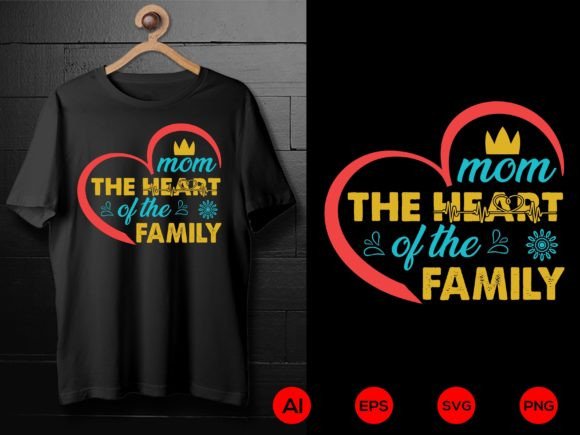
Mom T-shirt Design 40: A Designer’s Real-World Review
When I first pulled up Mom T-shirt Design 40 on my screen, I was not looking for another generic clipart file. As someone who spends hours digitizing and testing patterns for clients, I look for specific traits: clean lines, balanced negative space, and versatility across different fabric types. This design, centered around the phrase "MOM THE HEART OF THE FAMILY," immediately struck me as a strong contender for sentimental gift projects. However, a pretty preview image is very different from a stitched reality. I decided to put this graphic through its paces to see if it holds up in actual production environments.
First Impressions and Visual Personality
The immediate mood of Mom T-shirt Design 40 is warm and grounded. It does not rely on overly complex flourishes or trendy fonts that might date quickly. Instead, it offers a classic, heartfelt aesthetic that appeals to a broad demographic. For embroidery designers and Etsy sellers, this is crucial. You want a design that feels personal but remains legible from a distance. The layout suggests a central focal point, likely ideal for chest placement on apparel or the center of a tote bag.
Since the product description highlights that you receive AI, EPS, PNG, and SVG files, we are dealing with vector-based graphics. This is a significant advantage for us in the pre-production phase. Being able to resize vector shapes without losing quality means we can adapt the design for various hoop sizes before converting it into a machine embroidery design. The claim of "100 print ready" and "easy change color" suggests that the layers are well-organized, which saves time when preparing mockups for clients.
Real-World Application Scenarios
I recently worked on a custom order for a boutique client who wanted matching items for a family reunion. I considered using Mom T-shirt Design 40 for a series of sweatshirt embroidery projects. The design’s structure seemed robust enough to handle the thicker texture of fleece without getting lost. In this scenario, the clarity of the lettering would be paramount. If the stitches are too dense, the fabric puckers; if they are too sparse, the background shows through awkwardly.
Beyond apparel, I tested the concept on a canvas tote bag design. Canvas has a loose weave, so designs with fine details can sometimes sink into the fabric. However, because this design appears to have bold, solid shapes, it translates well to heavier materials. It would also make an excellent embroidered patch for denim jackets or backpacks. The "heart of the family" theme resonates deeply in the personalized gift market, making it a reliable seller for holidays like Mother’s Day or Christmas.
Technical Considerations for Stitching
While the vector files provide great flexibility, converting them into a usable embroidery file requires careful attention. Here is where my experience as a reviewer comes into play. You cannot simply auto-digitize a complex SVG and expect perfection. You must consider stitch density and direction.
- Fabric Texture: On textured fabrics like terry cloth towels or waffle-knit blankets, ensure your fill stitch coverage is sufficient. Thin areas may disappear into the pile.
- Stabilizer Choice: For stretchy fabrics like jersey t-shirts, a cut-away stabilizer is non-negotiable to prevent distortion. For woven caps or hats, a stiff backing is required to support the design on curved surfaces.
- Thread Colors: The design allows for easy color changes. I recommend testing high-contrast combinations first. A dark thread on a light fabric reveals detail better than low-contrast pairings, which can look muddy from afar.
One area to watch is the lettering. Small serifs or intricate connections in the word "HEART" could cause thread breaks if the needle size is too large or the thread tension is too tight. Always run a test stitch-out on scrap fabric identical to your final project material. This step saves wasted garments and frustrated customers.
Where to Use Caution
Not every project is a good fit for every design. While Mom T-shirt Design 40 is versatile, there are limitations. Avoid placing this design on very thin, slippery fabrics like silk or rayon without extensive stabilization and experience. The weight of the embroidery threads can pull and distort delicate materials.
Additionally, be mindful of hoop size constraints. If you are working with a small 4x4 inch hoop, you may need to scale the design down significantly. At smaller sizes, tiny details merge together. I advise checking the smallest element of the design in a black-and-white mockup. If it looks like a blob at 50% scale, it will look like a blob when stitched. Simplify or enlarge as needed.
Commercial Value and Brand Consistency
For craft business owners, consistency is key. Using high-quality assets like Mom T-shirt Design 40 helps build trust. When a customer receives a finished product that looks professional, with clean edges and no loose threads, they are more likely to return. This design supports that goal by offering clear, reshapable vectors that allow for precise customization.
Whether you are creating baby embroidery for onesies or holiday embroidery for aprons, the emotional connection of the text adds value. It transforms a simple item into a keepsake. However, always verify the licensing terms. The description mentions commercial use potential, but confirming whether you can sell the digital file itself or only the physical stitched item is vital for legal compliance.
Final Verdict for Makers
Mom T-shirt Design 40 is a solid addition to any designer’s library of T-Shirt Designs and Graphics. It balances emotional appeal with technical practicality. The inclusion of multiple file formats empowers you to adapt the artwork for various mediums, from print to stitch. Just remember that the vector file is the starting point, not the end. Your skill in digitizing, choosing the right thread colors, and selecting the proper stabilizer will determine the final quality.
If you are an embroidery project enthusiast looking for a reliable, heartwarming design that performs well on standard apparel and home goods, this is a worthy candidate. Test it, tweak it, and make it your own. The best results come from understanding both the art and the mechanics behind the stitch.